Packaging Trends for 2026

Since starting operations in 1852, Roberts Mart has aimed to stay ahead in packaging innovation, to seek out opportunities for customers that offer new solutions, increased practicality and above all packaging excellence. Most recently this innovation has largely been around sustainable innovation, providing packaging options that meet environmental goals for manufacturers and also the demands of the end consumer.
Packaging materials have been getting smarter, with the introduction of elements such as compostable films, bioplastics and plant-based materials. But it is also the shift in values that have affected changes in packaging, led primarily by Gen Z.
These days there is much more to a purchase choice. It involves believing in the brand, making selections based on values, integrity, sustainability; choosing brands which the consumer is comfortable supporting.
Driven by evolving technology, environmental pressure and the end consumer, 2026 will continue the demand for sustainable solutions. Not only does the packaging have to look great, it also needs to make the end user feel good too.
Refillable and reusable packaging
The refill and reuse trend we have seen in 2025 will continue with packaging designed to be refillable and/or recyclable, in order to reduce waste. Pouch packaging is playing a large role in this area and will continue to do so going forward.
Return schemes and consumer refill encourage and facilitate a circular economy which may see brands partner more closely with waste management and recycling companies to ensure recovered packaging re-enters production.
User convenient packaging
User convenient packaging will continue to prevail in the coming year. Packaging design is influenced by the end consumer and the need for more convenient solutions that provide easy opening and closure, easy use, such as pouring, and easy cooking in terms of steam or vented packs.
Smart & interactive packaging
Smart packaging will continue to gain momentum. This includes sensors and tags, such as NFC, RFID and temperature/humidity sensors which can be used in packaging to track freshness, monitor conditions, track location and trigger alerts.
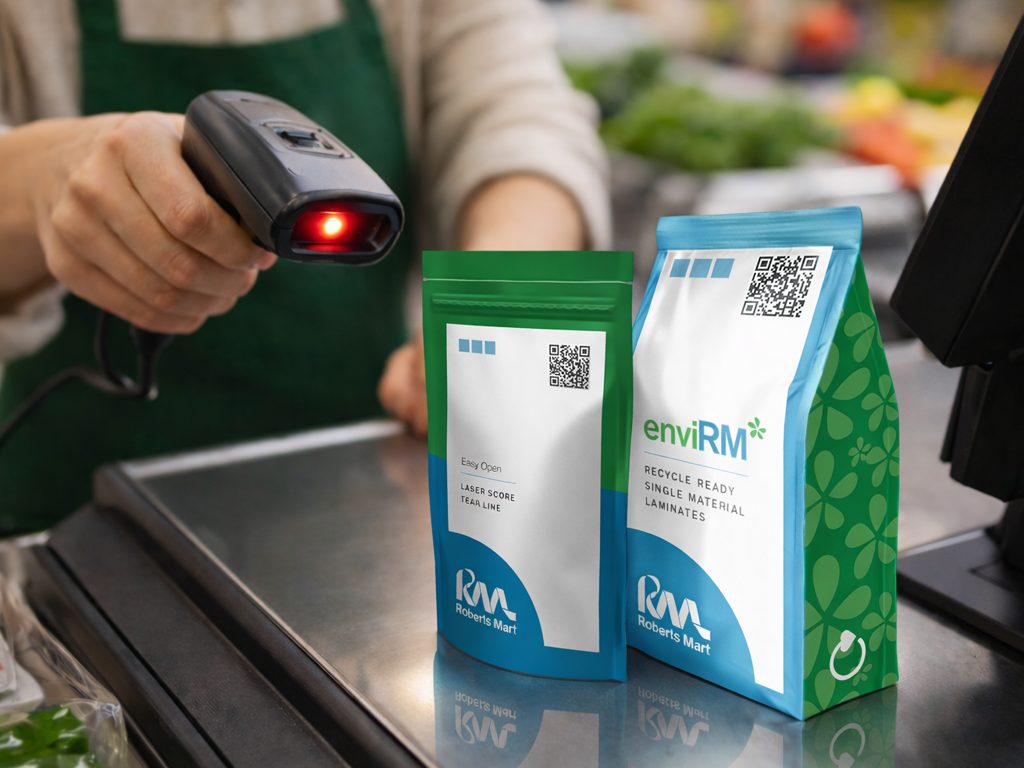
Intelligent packaging also encourages consumer engagement where customers can directly link from the packaging to information shown on their smart phone, to view product information, sustainability insights, competitions, recipes and more.
Smart packaging also supports circularity where digital watermarking or tagging helps with sorting and recycling in the waste management stage.
Mono-Material packaging and simplified structures
2026 will continue with the move from composite layers to the use of single mono-material designs such as all PP or all PE. This type of packaging is much easier to recycle and more compatible with existing recycling streams. Mono-material can be used for both flexible packaging, such as pouches and films, and more rigid formats.
Regulatory intervention
Growing regulatory pressure such as we have seen in the UK with the pEPR regulations introduced in January 2025, and the EU PPWR which will come into effect on 12 August 2026, will continue to affect packaging composition. These regulations have led the push for post-consumer recycled content, and we could see greater levels of inclusion in the future.
This still however needs to be balanced against maintaining barrier properties, safety, and performance.
Material efficiency
Producing packaging that is not only functional but also efficient in terms of transport and storage will remain an important consideration. Reducing the amount of material used in packaging, means a lighter package to transport and therefore lower carbon footprint and transport costs.
In summary, for 2026, packaging manufacturers in the FMCG sector are likely to be strongly driven by sustainability, circularity, and material simplification, supported by technical innovations and regulatory pressure. Packaging design teams need to consider the end life of the packaging, its recyclability and reusability, from the drawing board up.
Getting the packaging right can be a true differential for a brand but ultimately while many consumers will care about sustainable packaging, in our current price sensitive retail environment, not everyone is willing to pay a premium.